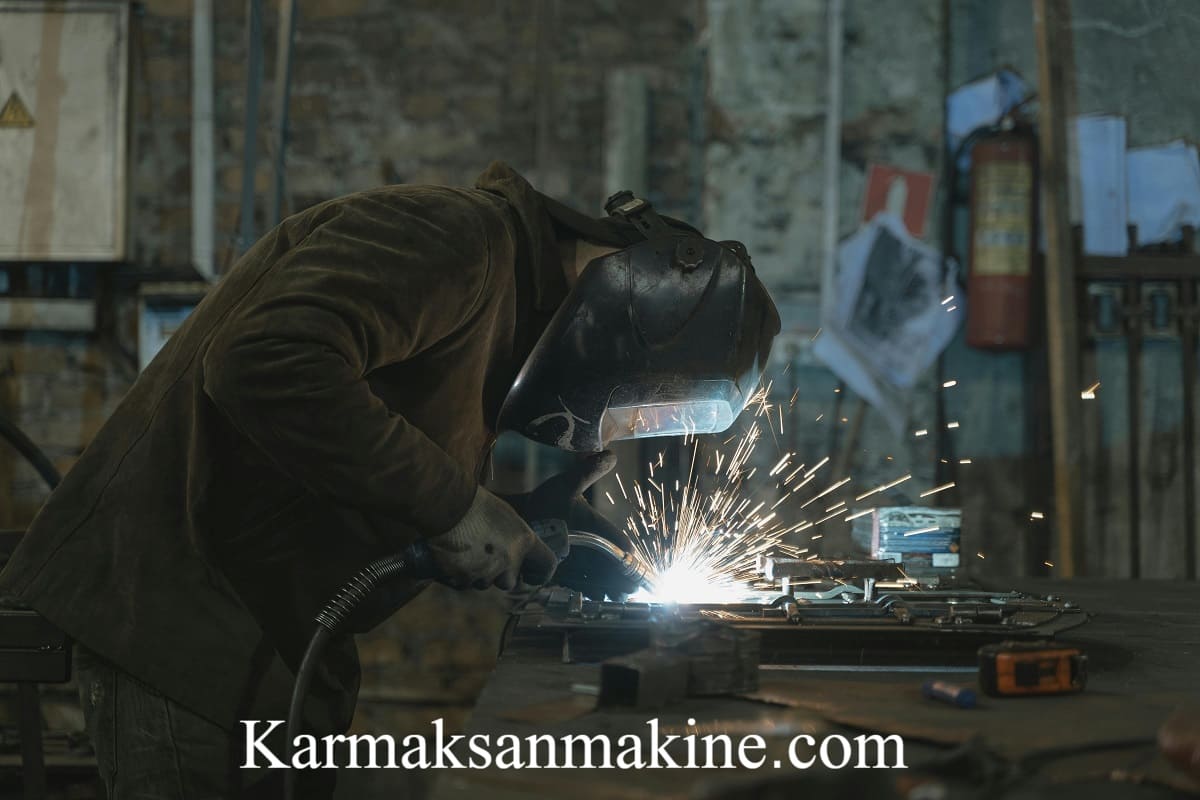
HEAVY DUTY AND HIGH STRENGTH
Automotive Sub-Industry and Deep Drawing Operations
During the growth phase of industrial facilities, one of the most challenging levels reached by sheet forming and mold cutting operations is undoubtedly the 150-ton pressing barrier. Incorporating a massive heavy industry press machine into your machinery park directly determines not only your production volume but also the prestige of your business and the scale of heavy-duty tenders you can enter. One of the most robust and long-lasting actors of this league of giants, the 150-ton eccentric press models are the pinnacle of Karmaksan Machine engineering.
Since 1988, we have been offering Turkish industrialists not just a pile of iron, but smart systems that will continuously produce value for years. In areas requiring high strength, such as automotive main chassis parts, industrial tube-tank manufacturing, white goods bodies, and heavy agricultural machinery spare parts, the steel forging presses and sheet forming machines we design exhibit an unrivaled performance.
Vibration-Defying Chassis: Heavy-Duty C-Frame Body
The impact of a massive 150-ton force hitting the mold multiple times a second creates a stress on the floor and the machine body that is difficult to measure. Low-budget cast iron machines on the market cannot absorb the "shock waves" experienced at these tonnages, and over time, irreparable breaks occur in the body. The biggest difference of Karmaksan quality is that we build all our 150-ton productions using solid steel plates (ST-52), whose tension has been relieved in special furnaces, under heavy-duty C-frame press norms.
Furthermore, depending on customer demand and the dimensions of the mold to be attached, we also manufacture "H-Frame" (closed body) steel constructions that mathematically reduce flexing to zero. This unshakeable body architecture, especially when working with deep drawing molds that require the sheet to stretch without tearing, reduces mold wear by 40%, offering you flawless product geometry.
For Large Molds: Double Pitman Power Distribution
In 150-ton presses with a wide working table, delivering power from a single center (a single connecting rod) causes pressure loss toward the corners of the mold. This situation leads to the axial shifting (offset) of the ram in long progressive molds and incorrect pressing of the parts. Solving this problem from the root, Karmaksan engineering distributes the 150-ton power over the mold from two different points in perfect parallelism by using a double pitman heavy press infrastructure for a massive power like 150 tons.
The eccentric (crank) shaft, which is the heart of the system, is produced from Turkey's most durable steel alloys, processed with micron precision on grinding machines, and coupled to the pneumatic hydraulic clutch system. This geared (reducer) transmission mechanism prevents the motor from stalling, producing maximum torque even in the most demanding thick sheet cutting operations.
Unforgiving Technology: Hydraulic Overload Fuse
A jam caused by the operator or the mold in a 150-ton machine is a major disaster that leads to the crank breaking or the body exploding in traditional machines. However, in our machines, the mold overload fuse (hydraulic fuse) system, which has ceased to be an optional equipment and become standard, is present.
The hydraulic cushions inside the ram are protected by instantaneous sensors against pressure. In the event of a jam, the moment the pressure exceeds 150 tons, the fuse blows (discharges the oil) in the first millisecond, and the machine goes into neutral. Thanks to this system, your press and molds worth millions of liras are 100% protected. It only takes minutes to fix the malfunction and put the machine back into production.
Industry 4.0 Compliance and PLC Automation
The era of manually (by hand) feeding sheet metal to giant machines is over. To operate a 150-ton production giant at full capacity, we equip it with smart systems:
- Fully Integrated PLC Screen: A smart automation brain where stroke speed, mold memory, fault notifications, and maintenance schedules are managed from a single touch screen.
- Servo Driver Synchronization: Our PLC automated press infrastructure operates continuously in perfect synchronization with coil unwinders and servo drivers in your factory in milliseconds.
- Advanced Ram Balance Cylinders: It extends the life of the motor and brake system by pneumatically (air cushion) balancing the load placed on the ram by heavy upper mold parts.
- Central and Automatic Lubrication: Continuously lubricates the guides, heavy bearings, and cranks of the machine in a dosed and pressurized manner without leaving it to the operator's initiative.
Heavy Machine Revision and Facility Renewal
Buying a brand new high-tonnage machine may not be easy for every business. However, if you have an old heavy press with a mechanical clutch that sits idle in your factory and fails to meet occupational safety (CE) standards, we would like to remind you that as Karmaksan Machine, we are one of the most reliable press revision companies in the industry.
We recreate your old mechanical giants from scratch with the expert staff of our factory. We renew all worn bearings and bronze parts, and integrate current pneumatic clutch and hydraulic fuse equipment into your old workbench. The machine returning to your factory transforms not just into a painted pile of iron, but into a smart production facility bearing all the technological features of a zero-press.
Visit our contact page immediately to learn about the advantageous Karmaksan machine prices offered to you directly from our workshop without intermediaries, which will take your production volume to the league of giants. For your special tonnage and dimension projects, you can instantly start talking to our engineers via the WhatsApp support line in the bottom right corner of our page.
Frequently Asked Questions (FAQ) About the 150-Ton Eccentric Press
1. What is the sheet metal cutting capacity of the 150-ton eccentric press?
150-ton presses are easily used in cutting and punching heavy steel sheets between 8mm and 12mm depending on the reducer torque and mold structure.
2. Why is the Double Pitman important in 150-ton presses?
In wide working tables, it is vital to distribute the 150-ton power from two separate points rather than the center to prevent the ram from tilting (flexing) to the sides.
3. What is the deep drawing distance (stroke length) of the Karmaksan 150-ton press?
Standard stroke lengths are shaped according to customer needs, and high-stroke productions are made with special slowed reducer transmission for deep drawing molds.
4. Can hot steel forging be done with this press model?
Yes. Thanks to special alloy steel cranks and high-torque gear groups, our 150-ton presses show superior performance in hot steel forging and forming operations.
5. What is the flexing margin of the heavy-duty C-Frame 150-ton press?
Thanks to the extra-thick ST-52 steel construction and heat-treated body, the flexing is kept close to zero (at the micron level) compared to standard C-type presses.
6. How does the hydraulic overload fuse react in 150-ton presses?
When the pressure instantly exceeds 150 tons, the sensors trigger the system, and the oil valves open in milliseconds, preventing mechanical jamming and protecting the crank.
7. What press data can be monitored from the PLC automation screen?
Stroke per minute (SPM), produced part count, lubrication timer, error-fault codes, and servo driver synchronization settings can be monitored instantly from a single screen.
8. What is the mold mounting area (table size) of the 150-ton capacity press?
In addition to standard productions, we can manufacture special table sizes that will fully adapt to the progressive or massive casting molds used by your business.
9. How is synchronization achieved with coil unwinders and servo drivers?
The press's PLC automation brain sends 'feed sheet' or 'stop' signals to the driver unit according to the position of the ram, ensuring 100% error-free and continuous operation.
10. How many strokes per minute (SPM) can 150-ton presses make?
Depending on the type of operation (cutting, bending, or deep drawing), the reducer transmission ratios are specially designed to reach speeds between 30 and 60 strokes per minute (SPM).
11. Which welding method is used on the 150-ton press chassis to prevent vibration?
High-penetration, robotic, and gas-shielded welding technology is applied to increase strength; then the body is baked to relieve thermal stress.
12. Why should revision be preferred over a second-hand 150-ton press?
Hidden body cracks and worn mechanical clutches in second-hand presses create occupational safety risks. In revision, the old machine is recreated from scratch with zero pneumatic systems.
13. What is the average motor power (kW) of Karmaksan 150-ton presses?
Although determined according to the speed and tonnage needs, new generation high-efficiency and low-consumption industrial motors with inverters are used.
14. How much air does the pneumatic clutch and brake group consume in 150-ton presses?
It is optimized according to the clutch volume used. It works economically and smoothly with the air provided from the standard compressor line in your factory.
15. Which sectors does the 150-ton press serve in heavy industry?
It is ideal for the automotive sub-industry, tractor and agricultural equipment manufacturing, white goods bodies, steel door manufacturing, and defense industry parts.
16. How long does it take to adjust the mold height in 150-ton presses?
Thanks to the motorized ram adjustment, the operator can adjust the mold height in seconds just by using the arrow keys on the PLC screen without using heavy wrenches.
17. Why do you use a steel construction chassis instead of a cast steel chassis?
Cast bodies tend to crack or break under heavy shocks. Steel construction chassis are much more durable because their flexing margin is close to zero.
18. What is the installation and commissioning time of a 150-ton press?
After the machine is delivered to your factory, mechanical, electrical, and PLC connections are made by our engineers within 1-2 business days, making it ready for production.
19. How is the maintenance of the machine's pneumatic balance cylinders done?
Because balance cylinders work on the air cushion principle, they require very low maintenance. Periodic checking of the lubricator and water traps (conditioner) in the air line is sufficient.
20. Are occupational safety barriers (light curtains) standard in 150-ton presses?
Absolutely. Light curtains and dual hand control panels are mandatory on all our machines to protect worker health and meet European CE standards.
21. What type of oil does the central automatic lubrication system use?
Industrial liquid slideway oils or liquid greases determined according to the mechanics and slides of the press are fed into the system with dosing pumps.
22. Can aluminum or stainless steel be formed with a 150-ton press?
Yes. Thanks to the reducer transmission ratios adjusted according to the characteristics of the sheet, hard materials like stainless steel or soft materials like aluminum are formed flawlessly.
23. Is there a disadvantage of the double crank structure compared to single crank presses?
There is no disadvantage; on the contrary, by dividing the power in two at weights like 150 tons, it extends mold life and prevents product defects (off-size parts).
24. What is the warranty period and scope of the Karmaksan 150-ton press?
The mechanical parts of the machines we manufacture are guaranteed for 2 years against manufacturing defects, and we have a spare parts supply guarantee for 10 years.
25. Does the ram of the 150-ton press drop suddenly in the event of a power outage?
No. The pneumatic clutch and brake system locks the system with a massive spring force the moment air and electricity are cut off, 100% preventing the ram from falling.
26. What should businesses consider when buying a 150-ton press?
Attention should be paid to whether the body is heat-treated, the bronze quality of the crank and connecting rod bearings, and whether there is a hydraulic fuse.
27. Can a PLC system be installed on an old-type mechanical 150-ton press?
Yes, the Karmaksan revision team can cancel old mechanical systems and perform full touch PLC screen integration along with a pneumatic clutch.
28. What happens if the operator releases the dual hand buttons while the machine is running?
For occupational safety reasons, if the operator removes one or both hands, the pneumatic brake is instantly activated and locks the machine in milliseconds.
29. How is mold jamming (swelling) resolved in 150-ton presses?
Thanks to the hydraulic fuse equipment, the oil is discharged at the moment of jamming, and the machine is freed. The operator solves the problem in minutes without using heavy jacks or oxygen cutting.
30. How is the container loading of 150-ton presses done for export?
These massive machines are safely loaded into Open Top or Flat Rack containers using cranes, after being protected with anti-corrosion applications suitable for overseas shipments.
Related Tags and Categories:
 Türkçe
 Русский
 Deutsch
 中文
中文